Need help? Call Us +1 (604) 503-9669

Need help? Call Us +1 (604) 503-9669
Published on: August 17, 2026
Canadian employers often ask a simple but important recruitment question: How long should I advertise a job before deciding whether my recruitment campaign has been successful?
There is no single advertising period that is right for every vacancy. For general recruitment, the ideal job posting duration depends on factors such as the occupation, location, available labour supply, required qualifications, urgency of hiring and how specialized the position is.
Quick Answer: A short posting period may work for positions with a large local candidate pool, while difficult-to-fill, specialized, rural or ongoing positions may benefit from 60, 180 or even 365 days of visibility. Employers should choose a posting period based on their actual recruitment needs rather than assuming that every position requires the same advertising duration.
For employers looking to reach First Nations, Métis, Inuit and other qualified job seekers across Canada, a longer advertising period can also provide more opportunities for candidates in different communities and regions to discover the position.
Recruitment is not always immediate.
A qualified candidate may:
not see an advertisement during its first few days;
live outside the employer's immediate community;
need time to review the opportunity;
need time to update a resume;
be considering relocation;
currently be employed and not searching for jobs every day; or
discover the vacancy through a specialized employment platform later in the recruitment campaign.
Keeping an appropriate job advertisement active for a reasonable period can increase the opportunity for suitable applicants to discover and consider the position.
However, longer is not automatically better.
The goal should be to select a duration that matches the employer's actual recruitment requirements.
The appropriate duration depends on the vacancy.
A useful way to think about job advertising is to divide positions into four broad recruitment situations.
A short posting period may be useful when:
the employer wants to test a new job board;
the position normally attracts many applicants;
there is a strong local candidate pool;
hiring is relatively urgent;
the employer is supplementing other recruitment activities; or
the employer wants to evaluate the response before purchasing a longer campaign.
For employers who have never used a specialized job board before, a short free or trial posting can also provide an opportunity to become familiar with the platform.
A 60-day posting can be appropriate for employers who want significantly more exposure without committing to a long-term recruitment campaign.
This may be useful for:
skilled occupations;
supervisory positions;
jobs requiring specific experience;
positions outside major urban centres;
employers recruiting across several communities;
positions where relocation may be required; or
businesses that want candidates to have more time to discover the opportunity.
A longer window can help employers move beyond applicants who happen to be actively searching during the first few days of recruitment.
Some positions are consistently difficult to fill.
An extended posting period may make sense when:
suitable candidates are limited;
the occupation requires specialized training or certification;
the employer hires for similar positions repeatedly;
the business operates in a rural or remote location;
relocation is commonly required;
there is significant competition for qualified workers; or
the employer wants sustained employment visibility.
A six-month advertising period can be particularly useful when recruitment is an ongoing business need rather than a one-time hiring event.
Year-round job advertising may be appropriate for organizations with continuing recruitment needs.
Examples can include employers that:
hire throughout the year;
operate multiple locations;
regularly recruit workers in the same occupation;
experience recurring employee turnover;
are expanding operations;
want a continuing employment presence;
regularly recruit specialized workers; or
manage a larger recruitment program.
Longer posting periods can help employers maintain visibility without repeatedly creating new recruitment campaigns for recurring employment needs.
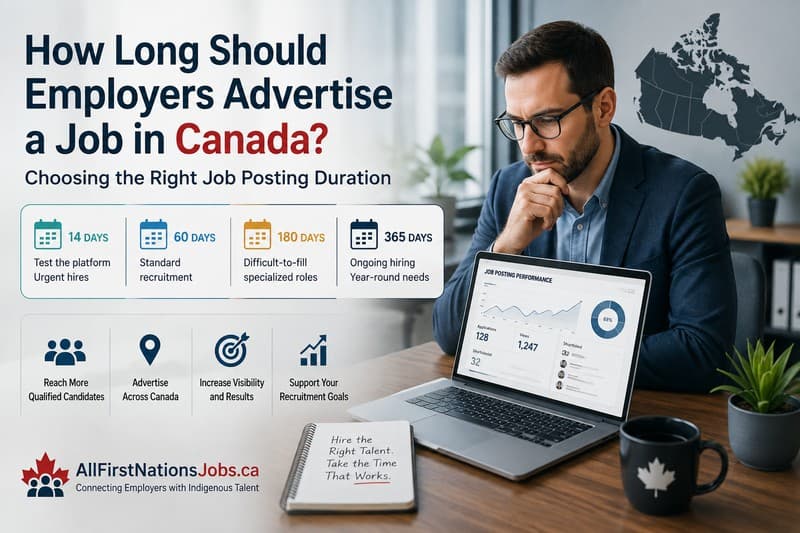
Posting DurationMay Be Suitable For14 DaysTesting a platform, urgent recruitment, commonly filled positions60 DaysStandard recruitment requiring broader exposure180 DaysDifficult-to-fill, specialized, rural or recurring positions365 DaysOngoing recruitment, multiple locations or year-round hiring
The appropriate duration should always depend on the employer's circumstances.
Not necessarily.
Job advertising duration is only one part of an effective recruitment campaign.
A poorly written advertisement can remain online for months without attracting suitable applicants.
Employers should also consider:
job title;
wage or salary;
work location;
required qualifications;
duties;
benefits;
schedule;
employment type;
application process;
workplace accessibility; and
whether the advertisement reaches the appropriate audience.
The right combination of quality, audience and duration is usually more useful than simply keeping an advertisement online for as long as possible.
Candidates should immediately understand what position is available.
Avoid internal company titles that may mean little to outside applicants.
For example, a recognizable occupational title is generally easier for candidates to search than an internal abbreviation.
Applicants need to know where they will actually work.
This becomes especially important when recruiting candidates from outside the immediate community.
Include the city or community and province or territory.
Clearly stating the wage or salary helps candidates determine whether the position meets their expectations before applying.
Transparent compensation information can also reduce applications from individuals whose wage expectations are significantly different.
A job advertisement should give applicants a realistic understanding of the position.
Focus on the most important duties rather than filling the advertisement with excessive or repetitive requirements.
Employers sometimes unintentionally discourage good candidates by listing every desirable qualification as mandatory.
Consider separating:
Required qualifications
from:
Preferred qualifications
This helps qualified candidates understand whether they genuinely meet the employer's minimum requirements.
Employers interested in broadening their recruitment efforts can include specialized employment platforms in their advertising strategy.
AllFirstNationsJobs.ca is designed to increase employment visibility among First Nations, Métis, Inuit and other qualified job seekers across Canada.
Using an Indigenous-focused job advertising platform can complement general recruitment activities by helping employers reach an additional employment audience.
Employers should still ensure that job requirements are based on the genuine needs of the position and that applicants are assessed fairly on their qualifications.
[Internal Link: Indigenous-Focused Job Advertising in Canada]
That depends largely on the position.
qualified workers are readily available nearby;
relocation is unlikely;
the occupation has a large local labour pool; or
the employer needs someone immediately.
workers are difficult to find locally;
the occupation is specialized;
candidates may be willing to relocate;
the employer operates in a rural or remote community;
several locations are hiring; or
the employer wants to reach a broader candidate population.
A Canada-wide online job platform allows candidates in different provinces and territories to discover employment opportunities without the employer having to restrict advertising to one local community.
Rural and remote employers may want to consider longer recruitment periods.
A candidate living in another region may need additional time to:
research the community;
consider relocation;
discuss the move with family;
understand transportation and housing options;
evaluate the compensation package; and
complete the application process.
For these reasons, a position that receives little response after two weeks may still generate suitable applicants during a longer recruitment campaign.
Employers should evaluate applicant quality and recruitment results before deciding that no suitable workers are available.
Not necessarily.
Receiving applications does not automatically mean that the employer has found a suitable candidate.
Employers may want to continue advertising until they have:
reviewed applications;
identified qualified candidates;
completed interviews;
checked required credentials or references;
selected a suitable candidate; and
reasonably confirmed that the candidate intends to accept the position.
Stopping recruitment too early can require an employer to restart the process if the preferred candidate later declines the offer.
Employers should periodically review an active advertisement rather than simply publishing it and ignoring it.
Look at:
number of applications received;
quality of applicants;
qualifications candidates are missing;
whether the wage remains competitive;
whether the duties are clearly explained;
whether location information is clear; and
whether the advertisement is reaching the intended audience.
If many applicants misunderstand the position, the problem may be the wording of the advertisement rather than the available labour supply.
Minor corrections may sometimes be necessary, but employers should be careful when making significant changes.
Changing items such as:
wage;
occupation;
work location;
required experience;
education;
job duties; or
employment conditions
can substantially change the nature of the advertised position.
Where the advertisement forms part of a regulated recruitment process, employers should be particularly careful to preserve accurate records and comply with the applicable requirements.
Yes.
This distinction is important.
For ordinary employer recruitment, the employer can generally select a posting period based on its business and hiring needs.
However, an employer using advertising as part of a Labour Market Impact Assessment (LMIA) recruitment campaign must comply with the specific requirements of the Temporary Foreign Worker Program.
Those requirements can include minimum advertising periods, particular recruitment methods, ongoing advertising and recruitment record requirements.
Employers should therefore not assume that a 14-day, 60-day or other general job posting period automatically satisfies an LMIA requirement.
Before selecting a job advertising duration, ask:
Common occupations may require less time than highly specialized positions.
A small labour market may justify broader and longer advertising.
Positions that may attract workers from other regions can benefit from longer exposure.
Ongoing recruitment may be more efficiently supported by a longer posting option.
An employer recruiting for several jobs should compare multi-posting packages rather than purchasing each advertisement separately.
If yes, confirm the applicable government rules before choosing the duration.
There is no single duration that is ideal for every general job advertisement. Employers should consider the occupation, candidate availability, location, qualifications required and urgency of hiring. Common recruitment campaigns may range from a short posting to several months of sustained advertising.
Two weeks may be enough for some positions with a strong candidate pool or urgent recruitment needs. Specialized, difficult-to-fill, rural or relocation-based positions may benefit from a longer advertising period.
A 60-day advertisement can provide substantially more exposure than a short-term posting and may be suitable for employers seeking a broader candidate pool or recruiting positions requiring specific skills and experience.
A 180-day posting may be useful for hard-to-fill jobs, recurring recruitment, specialized occupations or employers in areas where qualified applicants take longer to identify.
Year-long advertising can make sense for employers with ongoing hiring needs, multiple locations, recurring vacancies or occupations that remain continuously difficult to fill.
Yes. Online job advertising allows employers to make opportunities visible to candidates beyond their immediate community. Canada-wide advertising can be particularly useful when qualified workers may be willing to relocate.
Employers can broaden employment visibility through Indigenous-focused job advertising while maintaining fair and qualification-based hiring practices.
AllFirstNationsJobs.ca provides Canadian employers with a platform designed to increase visibility among First Nations, Métis, Inuit and other qualified job seekers.
Not automatically.
LMIA recruitment is subject to specific Government of Canada requirements. Employers should verify the applicable advertising period, recruitment methods and other requirements for their particular LMIA stream.
Successful recruitment is not simply about posting a vacancy—it is about giving the right candidates enough opportunity to discover and consider it.
A Canadian employer filling a commonly available position may need only a relatively short recruitment campaign, while another employer recruiting specialized workers, hiring in a rural community or recruiting continuously may benefit from months of additional visibility.
AllFirstNationsJobs.ca offers Canadian employers different job posting durations and package options designed to support short-term, extended and ongoing recruitment needs.
Whether you want to test the platform with a short posting or maintain longer-term visibility, choose an advertising option that matches your actual hiring requirements.
AllFirstNationsJobs.ca is an independent Canada-wide job advertising platform that helps employers promote legitimate employment opportunities and increase visibility among First Nations, Métis, Inuit and other qualified job seekers.
The platform does not act as a recruitment or staffing agency, select candidates or make hiring decisions on behalf of employers.